
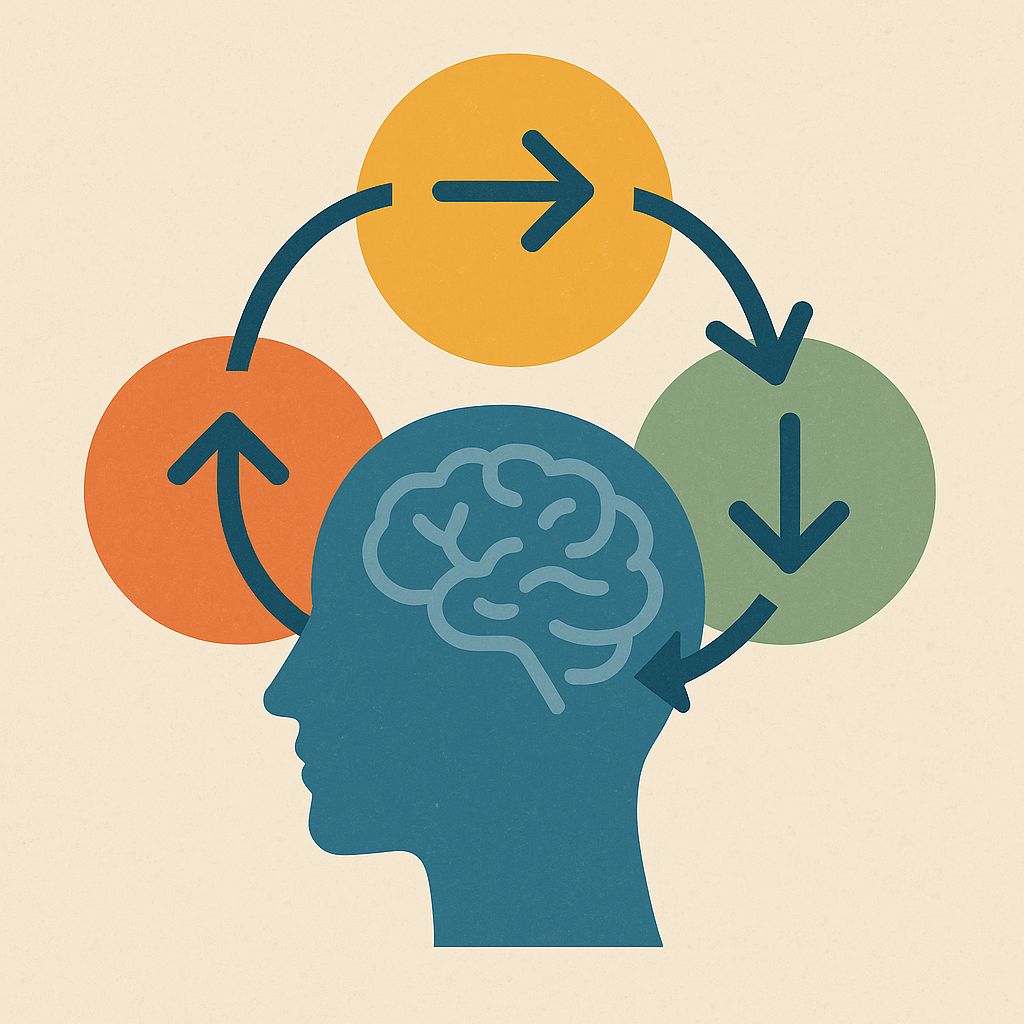
The core of RFT is that verbal humans have the ability to relate things to each other—even relations that are not immediately obvious and that have never been learned before—and these relations can alter how these things function or the effect they have on individuals. By “relations” we mean all the ways we might describe how one stimulus is similar to, different from, bigger or smaller than, a part of, contingent on, or otherwise associated with another stimulus. These relations are the “glue” that hold together many complex ideas and rules for behavior that can be adaptive or maladaptive (e.g., “Having one drink is a relapse, and if I relapse then I’m a failure, and if I failed, I might as well keep drinking.”). What makes RFT so innovative and important for ACT is that these ways of relating things have unique features, including (1) we have the ability to derive new relations that have never been learned; (2) coherence (making sense) functions as a reinforcer; (3) changes in functions can occur through derived relations; and (4) these relations and changes in functions are all controlled by context.
The ability to derive new relations
Humans have a unique capacity to relate things in new ways they have never learned before and that may not be immediately obvious. For example, try this right now. How is a toaster similar or different from a dog? It might take a minute because there are no immediate relations you have learned or that are obvious. But given enough time, you could probably derive a relation between the two— they both are essential parts of any good household, they both eat bread if given the chance, one should be on the counter and the other should not, one runs on electricity and the other on treats and love, and so on. We know from a long series of carefully controlled studies that humans have the ability to derive relations that have never been taught (Hayes et al., 2001). This can work well in some situations, like if you had to figure out how to escape from a dangerous situation you have never been in. Yet, it can also create challenges, like if you thought you had to escape from a situation that is not actually dangerous. Through the process of being able to relate anything to anything else, we have a fantastic ability to evaluate, plan, create, and problem-solve in ways that make our species incredibly successful. However, we also have a fantastic ability to evaluate in unhelpful judgmental ways, to come up with ineffective plans for events that will never occur, to create new ways of making ourselves and others miserable, and to problem-solve things that are either not problems or not solvable. In any moment, we can relate seemingly trivial, neutral things to incredibly aversive, upsetting things, thus greatly expanding our capacity for suffering. For example, we can associate anything with the label “bad,” including our bodies, feelings, and thoughts, and such associations can be unhelpful if we then respond to these stimuli accordingly.
Coherence as a reinforcer
The second key feature identified by RFT is that these relations are reinforced by coherence, meaning we relate things that make sense and seem logical. Again, this is a useful cognitive process because it is usually adaptive to think logically and not contradict ourselves. But this also means relating is automatically reinforced by coherence and thus can continue to elicit and strengthen the ongoing behavior without conscious attention. Much like how eating each chip in a bag of chips What Is Acceptance and Commitment Therapy (ACT)? 9 9 can be automatically reinforcing and lead to the next chip, we can keep “making sense of things” all day. This might explain the automatic nature and frequency of thinking. We are constantly relating things to each other, seemingly on autopilot, and without much ability to control it. We do not relate things based primarily on what makes us feel good or helps us but rather what makes sense. Consequently, we can get wrapped up in an ongoing stream of a logical story about how we are not good enough, will never be loved, should give up, and so on. Again, as this process is automatic, ACT uses strategies (mindfulness, acceptance) to observe this process and choose when to be regulated by it.
Changes in function
We might be able to relatively easily manage just these two features of relating anything to anything else on an almost constant loop based on what “makes sense,” if not for a third feature. The ways we relate things change how these things function. If we were constantly evaluating ourselves and thinking about how we are terrible but it did not change how we felt, acted, or otherwise engaged in the world, it probably would not be a big deal. But in actuality, how we relate (or think about) things affects all these other aspects of our functioning. The thought “I can’t handle my anxiety” can transform the discomfort of anxiety into absolute fear as anxiety becomes something dangerous, unmanageable, and to be avoided at all costs. This can not only intensify an event but also change its overall meaning. For example, if being at home on a Friday night is related to “nobody likes me,” then watching a movie and relaxing at home can all of a sudden be a sad and lonely activity, despite its being an enjoyable event without that thought. This is all contextually controlled Although we can relate anything to anything and thereby change our experiences and reactions to these things, this process is not random. Rather, all these relations and transformations through relations are governed by context. This is why when you see the letters bat you do not immediately have all the reactions you would normally have to seeing a disgusting, flying rodent (apologies to bat lovers) as well as to playing baseball. Rather, the symbols associated with bat only have meaning in context, such as your history with these symbols, the collection of symbols surrounding it, and the context in which you are interacting with this book. We could say “Get out, there is a fire,” but you probably would not run out the house right this moment because of the context. However, you might do that if someone woke you up at 3 a.m. yelling the exact same phrase. Context is extremely important in governing how we relate things and how things change as a result. This is extremely important for ACT as a functional contextual approach because it gives us a way to reduce maladaptive functions and build up more adaptive ones.
Read an extended, more technical explanation of RFT here.
 psihobubu